Translate

Showing posts with label countryside. Show all posts

Sunday, March 8, 2020

Posting to the other blog: stand by to teleport...


Dave and I took a hike around the Onkaparinga wetlands -- aka Perrybend Point -- the other day. I post-processed the pictures and did a rather nice blog post. I was just about to cross-post it here, and in the nick of time thought ... why would you bother? So (!) instead of cross-posting the whole thing, I'm just going to upload a couple of Teaser shots, and give you the link. Please do take a look -- it's a lovely place, and a very pretty post on the travel blog.

The other thing worth mentioning here is that I've been astonished at the traffic Meander to the Max is attracting. One post in particular (Halls Gap: Under the Mountain) is at 1,022 hits and counting. Others are way up in the high hundreds, which isn't too shabby for a private travel journal!

So, here's your link the the post, Wetlands Rule at Onkaparinga's Perrybend point. Enjoy!

Now, I'm delving into the photos from last week's expedition to Belair NP. There was this cheeky kookaburra who smelled fish, and came to roost in the rafters overhead, at the Pines pavilion...

And a couple of teaser shots, to whet your appetite:


Wednesday, October 2, 2019

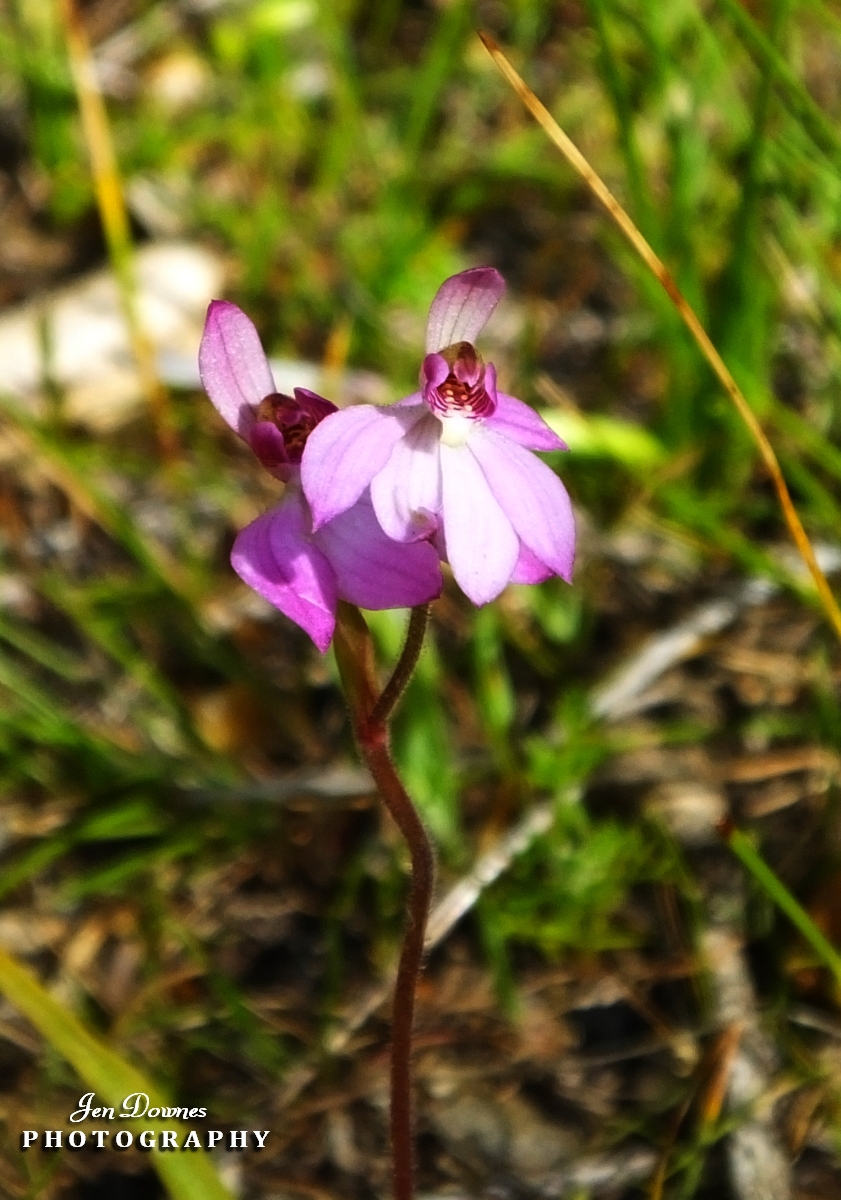
This year's 'orchid hunt' turns up treasure


It's been almost three years since Dave and I were able to be in the right place at the right time to hunt down Australian native orchids in their native habitat ... the woods. The last time we had the chance was back in 2016, before Mom passed away, before I was hospitalized myself, and before I was well and truly disabled (fall on a treadmill, banged up knee leading to plantar fascitis; fast forward twenty months from the fall, and I'm still trying to recover fully). The hike was a chore for me, but well worth it. Here's more evidence:


Many of these flowers are so tiny, so delicate and exotic, it's amazing to stumble over them almost in your own backyard. We live only about twenty-five minutes from Belair National Park ... and we know just where to look for these beauties!

Hunting orchids means hiking a long way while staring fixedly at the ground. Along the way, you'll also find a tremendous wealth of other wild flowers, which might not be as rare and exotic as orchids, but they're fleeting and beautiful...


Now, the last time we hunted orchids, it was mainly spider orchids we saw. This time around, we met a gent in the park who certainly sounded like an expert, but he said the spider orchids were all gone, we were too late this year. Here's where it gets a trifle odd: in 2016, we found a wealth of them -- in November. Hmm. I'm wondering if he mixed them up with some other kind, and if it would be worth going back at the end of October, and taking a look. Because we certainly found them in November a few years ago. Worth a try???

Spring has sprung in Belair, and it's the best time of the year:


...and this, above, is the very track we were walking when we found some of the most beautiful orchids. At the very beginning of October, there was real power in the sun. Enough to work up a sweat. Alas, these flowers won't last long ... we were lucky to be there on the right day.


Friday, April 26, 2019

Praying for rain


Headlines on radio the other day told South Aussies pretty much what we already know: we're struggling through the driest start to winter on record:


Sure, the skies are frequently overcast, but it almost never rains ... and when it does, it's a tiny patter of drizzle, not enough to make the garden moist, let alone get the winter graze growing to save the herds, or get the crops moving.

Dave and I took a drive across back roads in the Myponga - to - Tooperang region, and, well, see for yourself:


Above: Myponga Reservoir. In almost fifty years in this state, I've never seen it this low. The treeline shows you where the water level ought to be. Yes, there's plenty of water still in the catchment, but the levels how you what's happening in the hills, where rain ought to be falling, and isn't...


The small farm catchments are getting dangerously low; some have dried up entirely. I've seen cattle standing beside a six-inch lake of mud, with no grass in sight. Makes your blood run cold, while graziers across the country are reported as being "suicidal," as they watch their livestock stuffer and, eventually, cull numbers both to save what they can, leave the opportunity to start again later when the drought breaks, and to minimize suffering.

As you can see in the second picture, above, this paddock -- which by May should be green grass to the skyline -- looks like the beach. The wind blows, and the sand just drifts out into the road. This specific paddock is on the hill above Tooperang ... it's beef cattle grazing country:


Above: This is not the beach. It's the roadside. And that is scary. Want it charted scientifically? No problem. A quick hop over to the Bureau of Meteorology produces this:


...which gave the picture on March 31. Now add another month. It hasn't rained more than a day in April, in any one area, and even on that day it didn't rain enough.

To quote my favorite RCMP Mountie ... "Oh, dear."

Thursday, August 11, 2016

The Big Sneeze

'Tis the season to be sneezin' --
Is it mimosa or is it golden wattle? I don't (kershoo) even care any(kerchoo!)more.
South Australia in August ... okay. Ker-CHOO! At Woorabinda last week.
Mimosa and golden wattle. The air is full of pollen, the trees are raining it in yellow snow-like drifts. My eyes are red and itchy and my sinuses --! What can you say? It's just part of the landscape, always has been.Talk to indigenous Australians; they'll probably tell you legendary stories of the Great Sneezing of 20,000 years ago.

(Oddly enough, we were watching a couple of episodes of Luke's Kingdom just the other week, and you couldn't fail to notice, in the background, the woodland was golden. "Ah," says I, "this was filmed in August or September." The year? Oh, probably 1974, since the show went to air in 1975. What's really weird is, I have clear memories of it being on TV that year. Ouch!)

Right now the golden woodland looks like the "enchanted forest" you see in Alaska, all too briefly, but it's the other end of the scale: Alaska turns golden as the birch races through fall (or autumn, if you prefer), whereas these flowers riot as we head up out of winter and into spring.  See here for "enchanted forest" pictures from my Alaskan days. See here for some enchanted forest pics from Jupiter Creek just last year...

But one doesn't sneeze when the birch turns golden. Golly, I wonder why not, LOL. Wellll... the golden wattle was here before humans arrived ... but it reminds you, the dinosaurs died out around the time the first flowers appeared, which once prompted some paleontologists to hypothesize that the dinosaurs died of hayfever. I can surely empathize with them.

But the good thing is, spring is breaking out all over the place. About time. Winter always tends to outstay its welcome.

Kerchoo.

Tuesday, August 9, 2016

Just a walk in the park

Okay, I surrender: Pandora is determined to be a "princess," and heaven only knows how long it'll take before I have a functional laptop of my own. So --

Have switched to Dave's eMachine, which is a rebadged Acer with a nice big 16" screen; and the hardest decision was, which word processor to put on? I didn't want to overload this system with an office suite, because I really don't seen six or eight progs all rolled into one.

A quick squizz at Google was in order. "Best free word processor for Windows 7" ... and what a choice we have these days. Spoiled for choice. Open Office is too top-heavy -- a full-in office suite; Lotus Symphony is a "productivity package," and so forth. All I want is a word processor!

The pick of the bunch, after looking at a few reviews, seems to be AbiWord, so it's been installed already and I'm about to take it for a test drive. The first thing I like about it is the itsby-bitsy installer. At around 8MB, it's a quick download even on a connection as slow as ours. (We're scheduled to get the NBN next month.) The next thing I like is the interface: pleasantly familiar to anyone accustomed to the older versions of Microsquash. It's also a small footprint on the harddrive, and it starts up fast. All good points. All it has to do now is just be a competent word processor, do the job, save files to formats that can be read by other programs on other machines. Shouldn't be a problem ... and I'll let you know how it goes.

If anyone is interested, the link to get this open source gem is: http://www.abisource.com/.

Meanwhile, the impression of "early spring and hot summer ahead" was reinforced in the last few days, when the shade temperature rose into the 70s ... in what's technically still winter! Dave and I took a few hours away from the usual work and duty of care-giver activities...

Jen uses the Fuji HS50 to photograph Dave ...
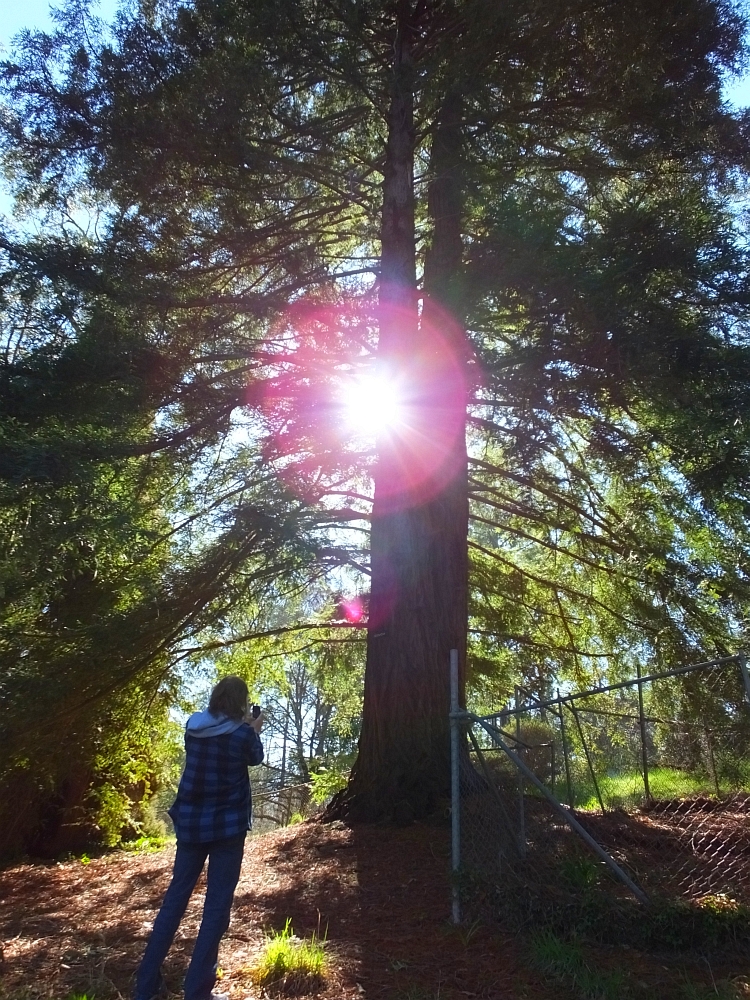
who's using a smartphone to photograph a sequoia.
...and we revisited a little park we had utterly forgotten until something jogged my memory just the day before. This hidden gem is on  the skirts of Aldgate: a lake, a trail around it, some glorious trees, a bird hide, some small trails heading off to pockets off bushland you can hike. Gorgeous! The sun angle shows you it's winter, because this was close to midday --

Dave uses the smartphone to photograph Jen
and some truly amazing lens flare.
Right above is a phone picture, just slightly tweaked in the computer. Dang, these phones do such good photos, it makes you wonder why I carry a big camera! Dave decided yonks ago to put the camera away and just run with the phone. Then again ... I got some very good shots with the aforementioned big camera (my Fuji HS50), and rather than loading up this little personal blog with them, I'll put them them into the travel blog, come back and link to that post from here. Neat.

Sunday, July 17, 2016

...and the wind howled like a banshee!

Sunday afternoon, and even the most diligent carer (care-giver, as our American cousins say) needs a break, if only for a couple of hours. With Mom just out of the hospital and still suffering with pneumonia, the level of care provided in-home is very intensive ... which tends to wear out the support crew. So, when she takes half an Ativan (Lorazepam) pill with lunch and settles down for a nap, time to leave Mike to hold down the fort, and run.

Objective: a walk in the fresh air, plus coffee.

Destination: Range Road West, top of the ridge above Willunga.

Mission Status: Accomplished! It was only a walk of about two miles, but a lot of it was uphill, the wind was cranking at about thirty miles per hour, and the wind chill dropped the temperature well below zero, so it felt like it was a lot further.

Dave the explorer braves the wind to get phone shots for facebook.
Conditions were mostly dull, overcast, but occasionally the sun broke through. Dave got some great phone shots, swiftly uploaded to his facebook page, and I was busy with the big camera --

Range Road Westis a well-packed dirt road through farmland
above the lovely town of Willunga.
-- while we hiked a hilly mile or so (and the same mile or so coming back) of Range Road West. You had to brace yourself against the buffeting of the wind, which howled like a banshee. It was actually very exhilarating. And when the sun broke through...

Dramatic skies, Irish-green hills, and a view of Willunga from up top.

...the view of Willunga "under the hill" was just beautiful. Got some very nice photos, and some striking memories of a big black bull on the hillside, at the edge of his territory: trumpeting into the wind -- either marking that territory by shouting over it, or "Calling all lady bovines!" What a din ... before he put his nose down and went back to his lunch.

After which, we headed down to Willunga for a quick coffee at the Golden Fleece before making tracks for home. Mom's alarm would be going off just as we got back.

Mission accomplished. One more Sunday afternoon in the life of a care-giver.
Related Posts Plugin for WordPress, Blogger...